
Mikiko Nagatake Trio: Breathe Beneath the Sun
Jazz of Japan #345 — From 2022, Breathe Beneath the Sun is pianist Mikiko Nagatake’s second release, a jazz piano...
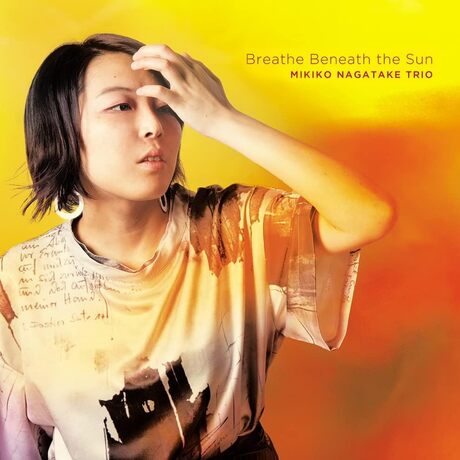
From 2022, Breathe Beneath the Sun is pianist Mikiko Nagatake’s second release, a jazz piano trio recording that came out just one year after her debut album Into the Forest (2021). With the same members as on her first album, her trio includes Ryoji Orihara on fretless bass and Sota Kira on drums, two popular players in many Tokyo jazz groups. Another similarity between Nagatake’s first two albums is the addition of special guest horn players on a few songs. While the first album featured saxophonist Nami Kano on a bonus track, this album features two more saxophone guests well-known in the world of Japanese jazz, Kosuke Mine and Eiichi Hayashi, who join Nagatake as special guests for one track each near the end of the album.
The sound of Nagatake’s jazz trio is compelling and modern, with a youthful style that is dynamic, energetic, and fun. Running at about 71 minutes, all ten tracks were composed by Nagatake and are bursting with her creative force, one that builds on the adventurous leanings of jazz pianists like Carla Bley and Cecil Taylor. Skillful and quick, Nagatake’s fingers can go from quiet and patient loveliness to a key-jabbing with barely contained energy, always in control but often peeking over the edge in risky provocation. Live audiences and album listeners cannot help but be drawn into her magnetic presence.
Here is a quick run through of the album flow. It starts with three highlights: #1 “Introduction -Breathe Beneath the Sun-” is Nagatake starting up the engines alone with a solo piano riff, deep and low on the keys with a rhythmically addictive pull and sharp lines coming in from above. The trio format begins with #2 “Not Even Heaven Knows”, a fiery and percussive fastball. #3 “Lucky You!” is another uptempo roller coaster with thrilling drops and bends, a frenetic Horace Silver-ish fever dream. #4 “Just Like He Sings” is a brushed ballad with the grace and sweetness of an Ellington/Strayhorn tune. #5 “Clover 9” is a wild and fast blues transmogrification, another album highlight (lots of these).
Track #6 “Teoribata” is a slower song written for bassist Orihara to shine peacefully in a long-form fairy tale. #7 “Say No More” has a classic hardcore dark jazz vibe with Chick Corea-esque Latin/straight waltz-time mix, grippingly edge-of-seat at a dangerous speed. #8 “I’ll Send You Good Vibes” is the first quartet track, as veteran saxophonist Kosuke Mine joins for a soulful and warm gospel/rock groove with his great playing. #9 “Nekokai no Ballad” continues the bluesy quartet atmosphere, gritty and genuine, with Eiichi Hayashi on sax, another distinctive and renowned Japanese jazz player. Finally, #10 “Get Ready to Say Goodbye” is a melodically beautiful and moving outro song with the elements of a hit pop song tenderly refracted through a Brad Melhdau-ish jazz prism.
Liner Notes
(Translated from the original Japanese liner notes.)
Introduction
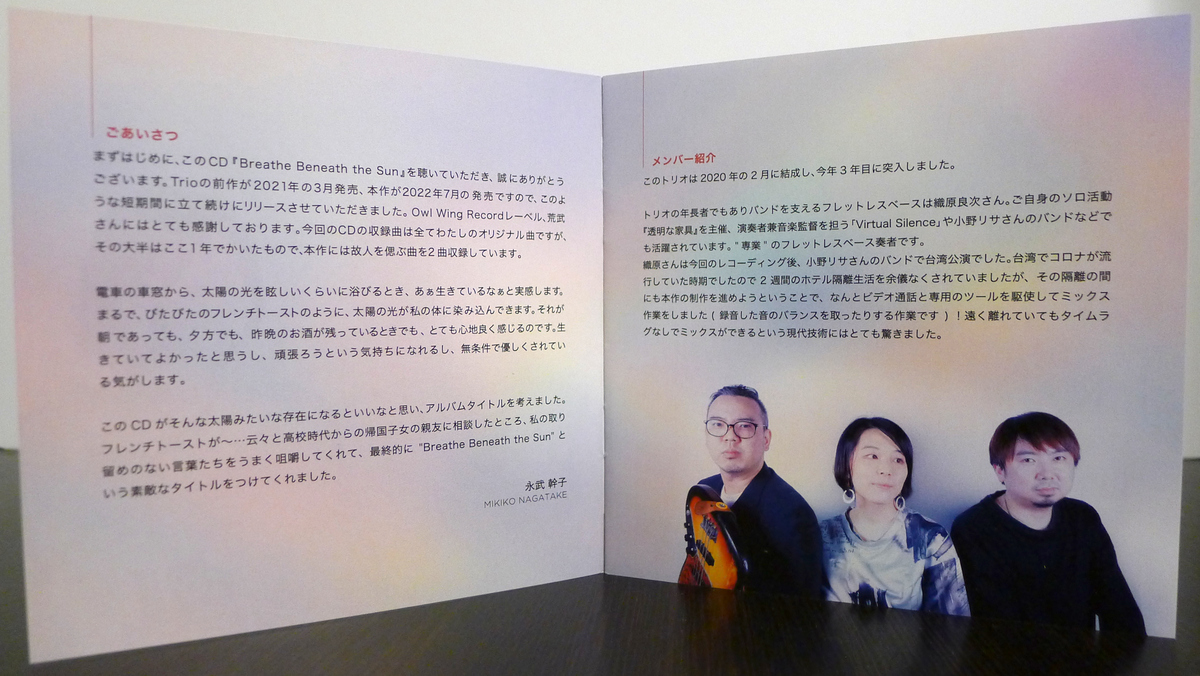
Before anything else, I would like to thank you very much for listening to this CD, Breathe Beneath the Sun. We’ve been fortunate to be able to able to release another trio recording in quick succession after the previous trio recording released in March 2021. I can’t express enough the appreciation I have for the label, Owl Wing Records, and Aratake-san. On this CD, all the songs are original compositions that I wrote over the past year, mainly, including two songs in the memory of people who have passed away.
When I am riding on the train and dazzling sunlight pours in from the train window and washes over me, I really feel alive. The sunlight permeates me just like soaking into French toast. Whether it’s morning, evening, or even if I’m still tipsy from the previous night, it’s always great. I realize how good it feels to be alive, and the motivation to do my best increases as I’m being treated with unconditional kindness.
I contemplated different album titles while thinking that it would be great for this CD to have that kind of presence of sunlight. I thought, Something like French toast or…, and so on. I tried to express my ramblings to a close female friend, a high-school classmate who returned from abroad, and she understood what I was trying to say perfectly. Ultimately, she gave me the wonderful title Breathe Beneath the Sun.
永武幹子
Mikiko Nagatake
Introducing the Musicians
In February 2020, this trio entered our third year together.
Ryoji Orihara, the trio’s senior member, supports the band on fretless bass. He’s active with his solo project “Invisible Furniture”, serves as a member and musical director of “Virtual Silence”, and plays with Lisa Ono’s band. He is a professional fretless bass player specialist.
After we finished recording this album, he went to perform in a concert in Taiwan with Lisa Ono’s band. This was at a time when coronavirus was spreading in Taiwan, and he was forced to stay quarantined in a hotel for two weeks. However, he wanted to keep working on this album even at that time. We made full of video conferencing and other specialized tools and finished the mixing (working on the sound balance of the recording)! I was so surprised at the modern technology that allowed us to do the mixing while being far apart, without any time lag.
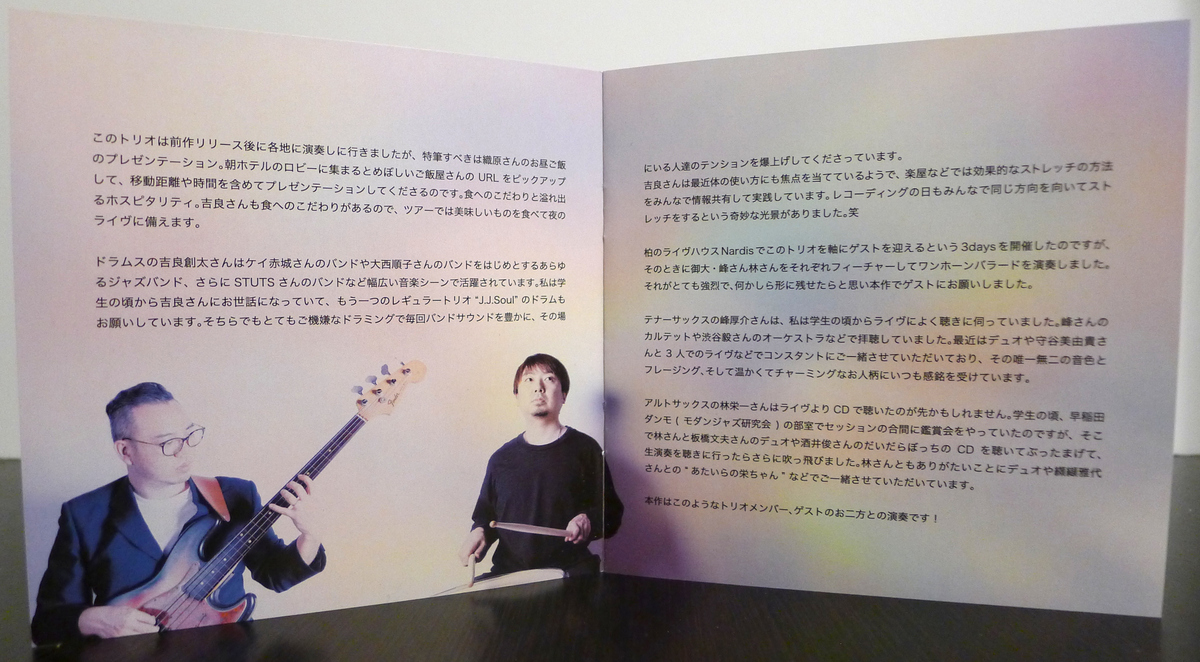
After this album was recorded, our trio went on to perform at various locations. One thing I have to mention is Orihara-san’s lunch presentations. In the mornings, we would gather in the hotel lobby and be treated to his presentation of notable restaurants in the area, including their websites, business hours, distance, and travel time. There was a passion for food overflowing with hospitality. Kira-san is also passionate about food, and so all throughout the tour we would prepare for the evening concert by having delicious meals.
Drummer Sota Kira is active in a wide variety of musical acts, from Kei Akagi’s band and Junko Onishi’s band (that is to say, he started with jazz bands) to even STUTS’s band and others. Kira-san has been supportive of me ever since my student days. He also plays drums in “J.J.Soul”, another of our regular jazz trios. There, too, his incredibly energetic drumming always enriches the band’s sound and boosts the excitement of everyone present.
Recently Kira-san has been focusing his attention on the proper ways of body movement. Backstage, he has been sharing his techniques and instructing us on effective stretching methods. Even on the day of the recording, there was quite an odd scene when everyone was facing the same direction and doing stretches (ha ha).
At the live venue Nardis in Kashiwa, there was a three-day event where our trio was featured as the core band with special guests. At that performance, the masters Mine-san and Hayashi-san were each featured on a one-horn ballad. It was so intense that I absolutely wanted to capture that in some form, so I asked them to make a guest appearance on this recording.
Since my student days, I have often gone to hear tenor saxophonist Kosuke Mine play. I’ve listened to him with Mine-san’s Quartet, the Takeshi Shibuya Orchestra, and others. Recently I’ve been working consistently with him in live concerts as a duo, and as a trio with saxophonist Miyuki Moriya. I am always moved by his one-of-a-kind tone and phrasing, and his warm, charming personality.
As for alto saxophonist Eiichi Hayashi, it’s possible that I heard him on CD before seeing him play live. When I was a student, there were special listening sessions in the Waseda Danmo (Modern Jazz Research Group) study room between jam sessions. That’s where I heard CDs like the Eiichi Hayashi and Fumio Itabashi Duo, and Daidarabocchi with Shun Sakai. I was totally blown away. When I went to see him play live, I was even more amazed. I’m so grateful that I am able to play with Hayashi-san in duos and with Masayo Koketsu’s “Ataira no Ei-chan”.
This recording is a performance featuring these kinds of trio members and two special guests!
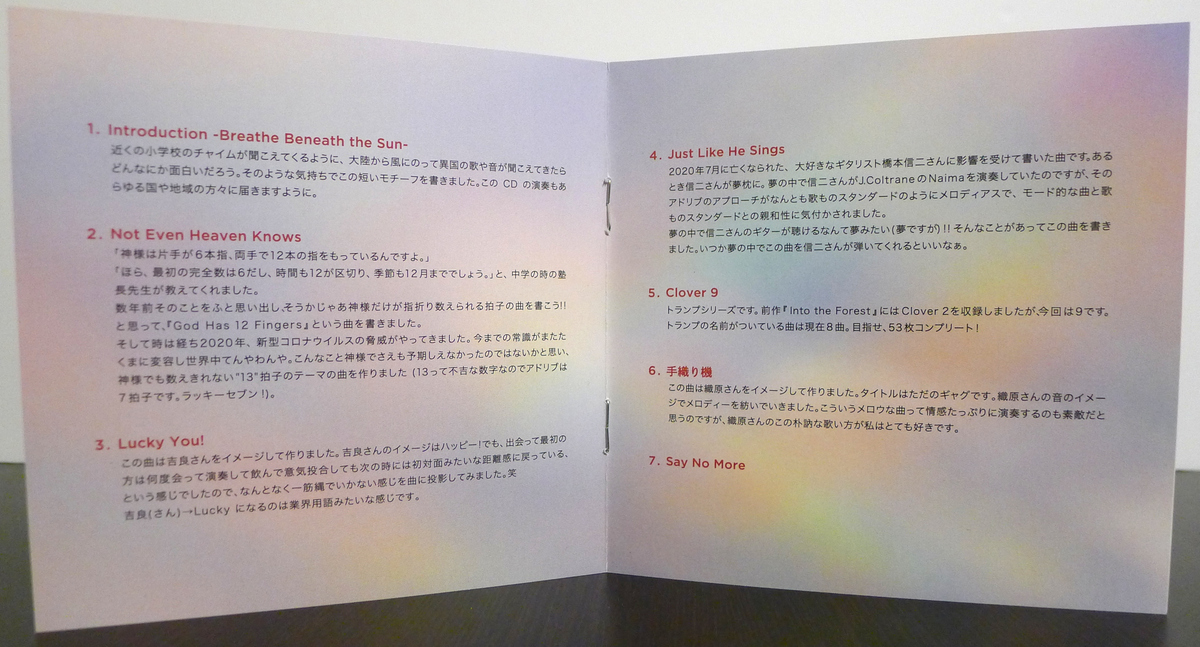
1.Introduction -Breathe Beneath the Sun-
In the same way that we can hear the chimes of nearby elementary schools, wouldn’t it be so interesting if we could hear the songs and sounds of foreign countries carried by the wind? I wrote this short motif with that kind of feeling in mind. I hope that the performance on this CD can also reach people in all kinds of countries and regions.
2.Not Even Heaven Knows
“God has six fingers on each hand and twelve fingers on both hands.”
“See, this is why the first perfect number is 6, time is divided into 12 parts, and the seasons also end with the 12th month.” This is what my private school principal taught me when I was in middle school.
I suddenly remembered this a few years ago and thought “I should write a song with a time signature that only God can count on his fingers!!” So I wrote a song titled “God Has 12 Fingers”.
Time passed, and the threat of the new coronavirus appeared in 2020. Conventional common sense changed in the blink of an eye, and the world was thrown into disorder. I couldn’t help but think that not even God could have predicted something like this. I wrote a 13-beat song with a theme that even Got could not count (but since 13 is an unlucky number, the improvisations are in a 7-beat meter. Lucky seven!).
3.Lucky You!
I wrote this song with Kira-san in mind. The image of Kira-san is happiness! Yet, around the time we first had met, no matter how many times we performed, drank, and hit it off together, the next time we met, it felt like we were meeting again for the first time. I tried to project a sense of that somewhat not-straightforward feeling into this song (ha ha). It feels as if 吉良(Kira)(-san) is taking on the meaning of “lucky” in the lingo of business buzzwords.
4.Just Like He Sings
I wrote this song inspired by Shinji Hashimoto, a guitarist I love who passed away in July 2020. One day, Shinji-san appeared in my dream. In the dream, Shinji-san was playing “Naima” by J. Coltrane, and his improvisational approach was melodious like a vocal jazz standard song. It made me realize the affinity between modal-style songs and vocal standard songs.
To be able to listen to Shinji-san’s guitar in my dreams was like a dream (well, it was a dream)!! That’s why I wrote this song. I would love it if Shinji-san would play this song in my dream someday.
5.Clover 9
The “deck of cards” series. The previous release Into the Forest included “Clover 2”, and this time it’s 9. There are currently eight songs in the “deck of cards” series. The goal is a complete 53!
6.Teoribata (手織り機, hand loom)
I wrote this song with Orihara-san in mind. The title is just a joke [/The title in Japanese is 手織り機, or hand loom, and Orihara is 織原, containing the same Kanji character 織/]. I spun the melody based on the image of Orihara-san’s sound. It’s really nice to play this kind of mellow song with such emotion, and I love Orihara-san’s simple style of singing.
7.Say No More
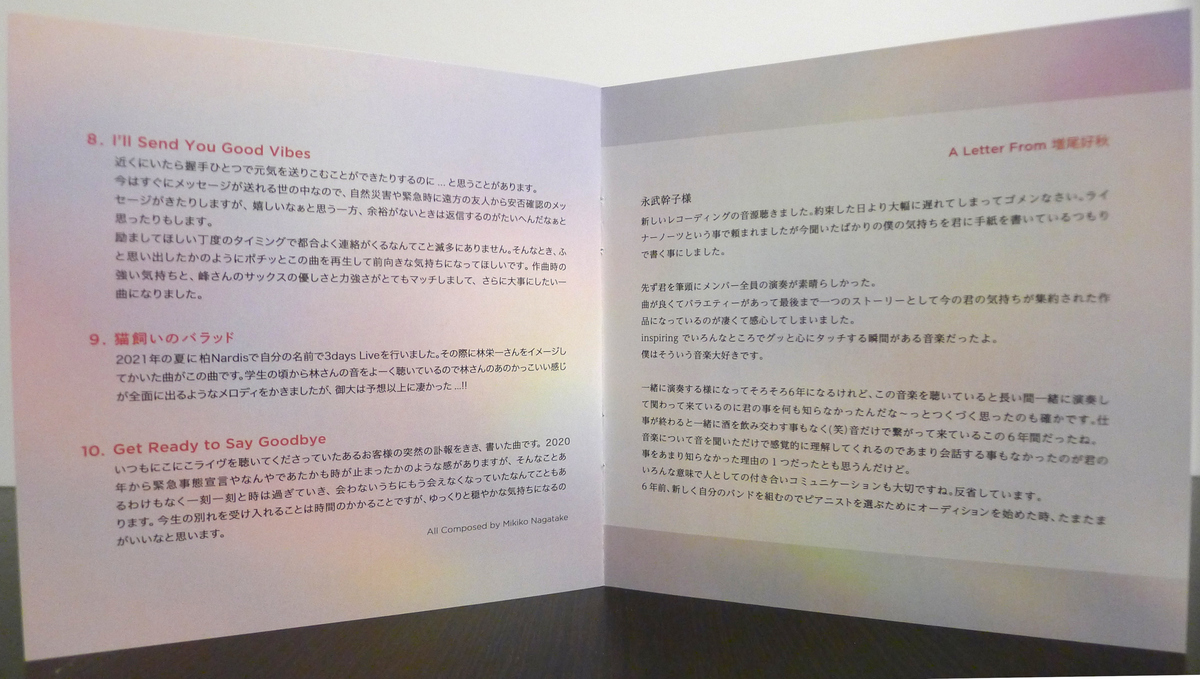
8.I’ll Send You Good Vibes
Sometimes I think that if I were close by, I could send some positive energy with just a single handshake. These days, when we live in a world where we can send messages immediately, it’s good to know that we can check on faraway friends’ safety when natural disasters and emergencies occur. On the other hand, it can feel stressful when there is just not enough time to reply.
It’s rare that the timing works out such that someone contacts you just at the right moment when you need encouragement. At time like those, I would love it if you suddenly remembered to play this song with a click as if it just came to mind, and to feel a sense of positivity. The strong emotions I felt when writing this song perfectly match Mine-san’s gentle yet powerful saxophone, and this makes it a song I cherish even more.
9.Nekokai no Ballad /(猫飼いのバラッド, Cat-keeping Ballad)/*
In the summer of 2021, there was a Mikiko Nagatake three-day event at Kashiwa Nardis. This is a song I wrote for that occasion while thinking of Eiichi Hayashi. I listened to Hayashi-san a lot in my student days. I wrote a melody for his kind of really cool Hayashi-san sound that stands out in all kinds of places, and the master was even more amazing than I expected!!
10.Get Ready to Say Goodbye
I wrote this song when I heard the news of the sudden passing of someone who always came to my shows with a smile. With the state of emergency and everything that began in 2020, it had felt as though time had stopped. But of course that wasn’t the case, and time passed moment by moment, and sometimes it was no longer possible to meet someone that you hadn’t seen in a while. Accepting a final farewell takes time, and I think it’s best to take it slowly and with a peaceful mind.
All Composed by Mikiko Nagatake
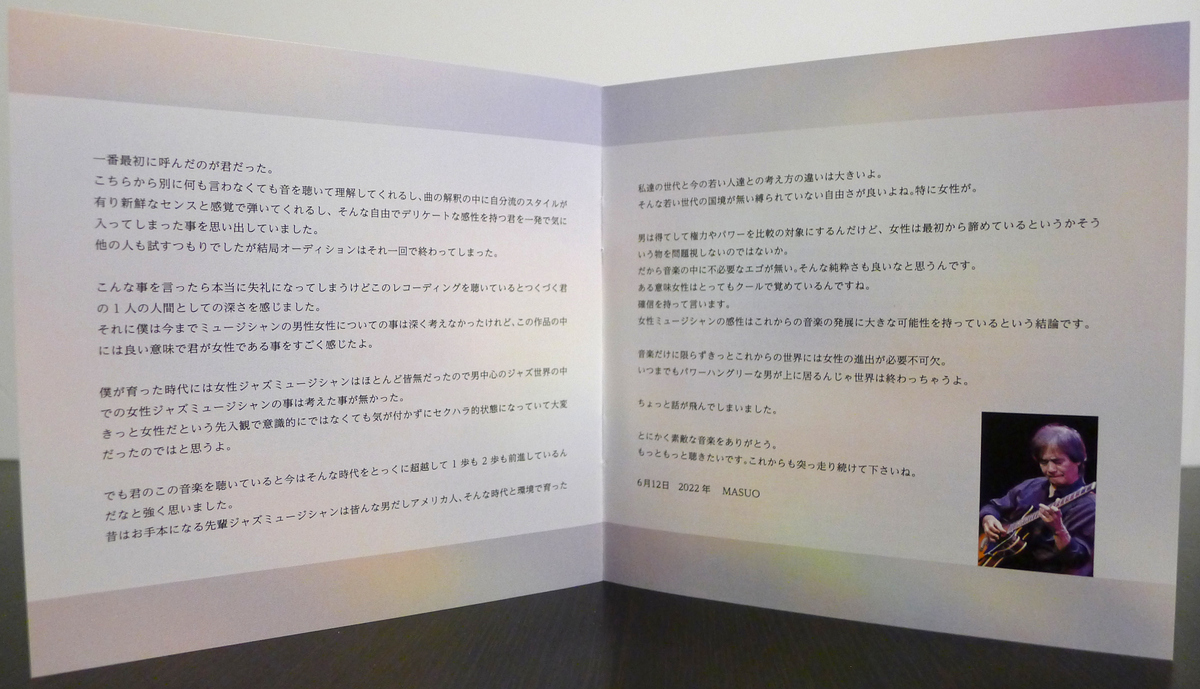
A Letter from Yoshiaki Masuo
Dear Mikiko Nagatake
I listened to the audio for your new recording. I apologize for the delay, later that the promised date. Although I was asked to write some liner notes, I decided to express my feelings in a letter to you after just listening to the music.
First, all the musicians beginning with you were fantastic. The songs are good and there’s lots of variety. I’m very impressed by how it sums up your current feelings and how it comes together as one story all the way through to the end. The music was inspiring, and there were many moments that touched my heart directly. I love that kind of music.
It’s been almost six years since we started performing together. But it’s true that, when I listened to this recording, I realized that I know nothing about you, despite our working so long together. We’ve been linked only through music during these six years, without even having a drink together after a concert (ha ha).
One reason that I don’t know much about you is because of your intuitive sense about music. Because you can pick up so much just from listening meant that there was not much need to talk about it. Of course, human interaction and communication is also important for many reasons, and I’m reflecting on that.
Six years ago, when I started to audition pianists for my new band, you happened to be the first person I called. By just hearing the music, you understood well without me having to say anything. You interpreted the songs with your own personal style a fresh sense and feeling. I remember how I instantly took to you, with your own free and delicate sensibilities, right from the start. I was planning to try out other people as well, but in the end it was just that one audition and it was over.
It may be quite impolite to put it this way, but when listening to this recording, I feel that I can truly understand your depth as a human being. Also, I’ve never thought too deeply about musicians being male or female before, but on this album I really get the sense of you as a women (with good meaning).
In the generation that I grew up in, there were almost no female jazz musicians, and in the midst of that male-dominated jazz world, I hadn’t really thought about female jazz musicians. Because of preconceived notions of women, there must have been very difficult situations, including sexual harassment, even unintentional in some cases.
However, when I listen to your music, I feel strongly that we have already transcended that era and progressed forward one or two steps. Long ago, back in my day, all the role model jazz musicians that we looked up to were men, and Americans. Now, there is a big difference in the way of thinking between that generation and environment that we grew up in, and those of the young people of today. It’s good that this young generation is free of those previous boundaries, and especially the women of this generation.
Men tend to use authority and power as a basis of comparison, but I think women may be resigned in those aspects from the start, or consider them to not be problems, perhaps. That’s why there is no unnecessary ego in the music. I think that purity is also good. In this sense, women are very cool and aware. I can say this confidently. A conclusion from this is that there is a great potential for the future development of music to be shaped by the sensibilities of female musicians.
For the future, the advancement of women is absolutely essential not just in music but also in the world. If the ones at the top are always power-hungry men, then, well, we are doomed.
Sorry, I went off on a tangent.
Anyway, thank you for the wonderful music. I want to keep listening to it more and more. Please continue to push forward.
June 12, 2020 MASUO
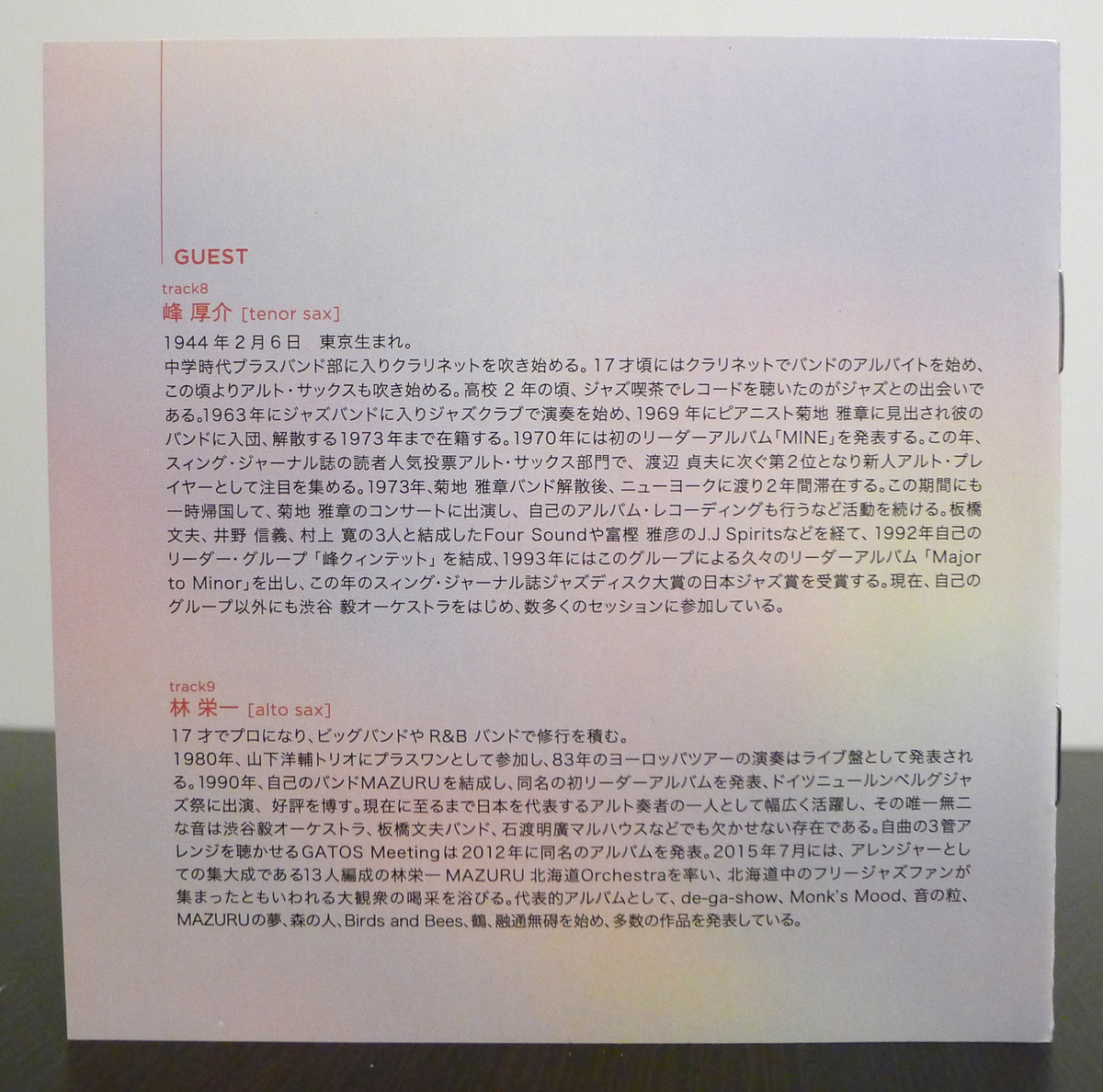
GUEST
track8
Kosuke Mine (tenor sax)
Born in Tokyo on February 6, 1944.
He began playing clarinet when he joined the brass band in middle school. He played clarinet in part-time bands when he was around 17 years old, when he also started to play alto sax. He first encountered jazz in his second year of high-school when he would listen to records at jazz kissas. In 1963, he joined a jazz band and started to play at jazz clubs. In 1969, he was noticed by pianist Masabumi Kikuchi and joined his band, where he remained until the band ended in 1973. He released his first leader album, Mine, in 1970. In that year, he ranked second in the magazine Swing Journal’s reader popularity poll in the alto saxophone category, right after Sadao Watanabe, and attracted attention as a new alto sax player. After Masabumi Kikuchi’s band ended in 1973, he moved to New York where he stayed for two years. During this period he also made brief trips to Japan to continue performing in concerts with Masabumi Kikuchi and to record his own albums. After playing with groups including Four Sound with Fumio Itabashi, Nobuyoshi Ino, Hiroshi Murakami, and Masahiko Togashi’s J.J.Spirits, he formed his group Mine Quartet in 1992 and released his long-awaited leader album Major to Minor in 1993, which won the grand prize for Japan Jazz in Swing Journal’s Jazz Disc Awards that year. Currently, in addition to playing with his own group, he participates in many sessions including with the Takeshi Shibuya Orchestra.
track9
Eiichi Hayashi (alto sax)
He became a professional musician at 17 years of age by training in big bands and R&B groups. In 1980, he joined the Yosuke Yamashita Trio as “Plus One”, and a concert recorded during their ‘83 European Tour was released as a live recording. In 1990, he formed his own band MAZURU and released an album under that name which was well received. To this day, he is active and widely recognized as one of Japan’s top alto players, and his inimitable sound is an essential part of groups including the Takeshi Shibuya Orchestra, Fumio Itabashi’s band, and Akihiro Ishiwatari’s Mull House. In 2012, he released GATOS Meeting’s self-titled album featuring his three-horn arrangements. In July 2015, in the culmination of his work as an arranger, he led the 13-piece Eiichi Hayashi MAZURU Hokkaido Orchestra where he was showered with applause from large crowds of free jazz fans who gathered all over Hokkaido. Among his numerous releases, his representative work includes de-ga-show, Monk’s Mood, Oto no Tsubu, MAZURU no Yume, Mori no Hito, Birds and Bees, and Tsuru.
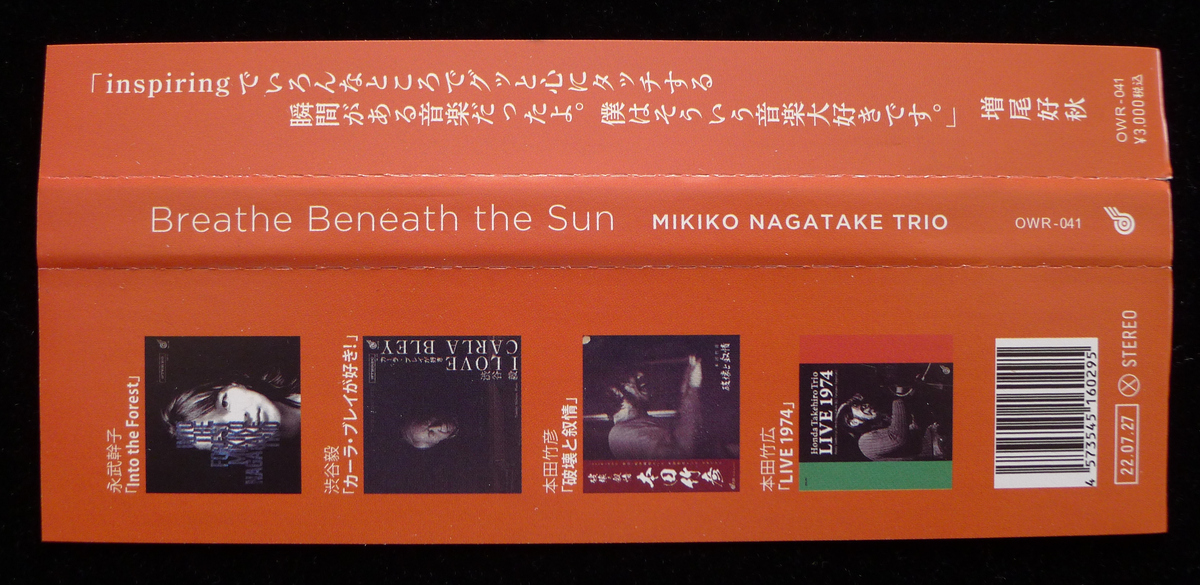
Obi Notes
“The music was inspiring, and there were many moments that touched my heart directly. I love that kind of music.” Yoshiaki Masuo
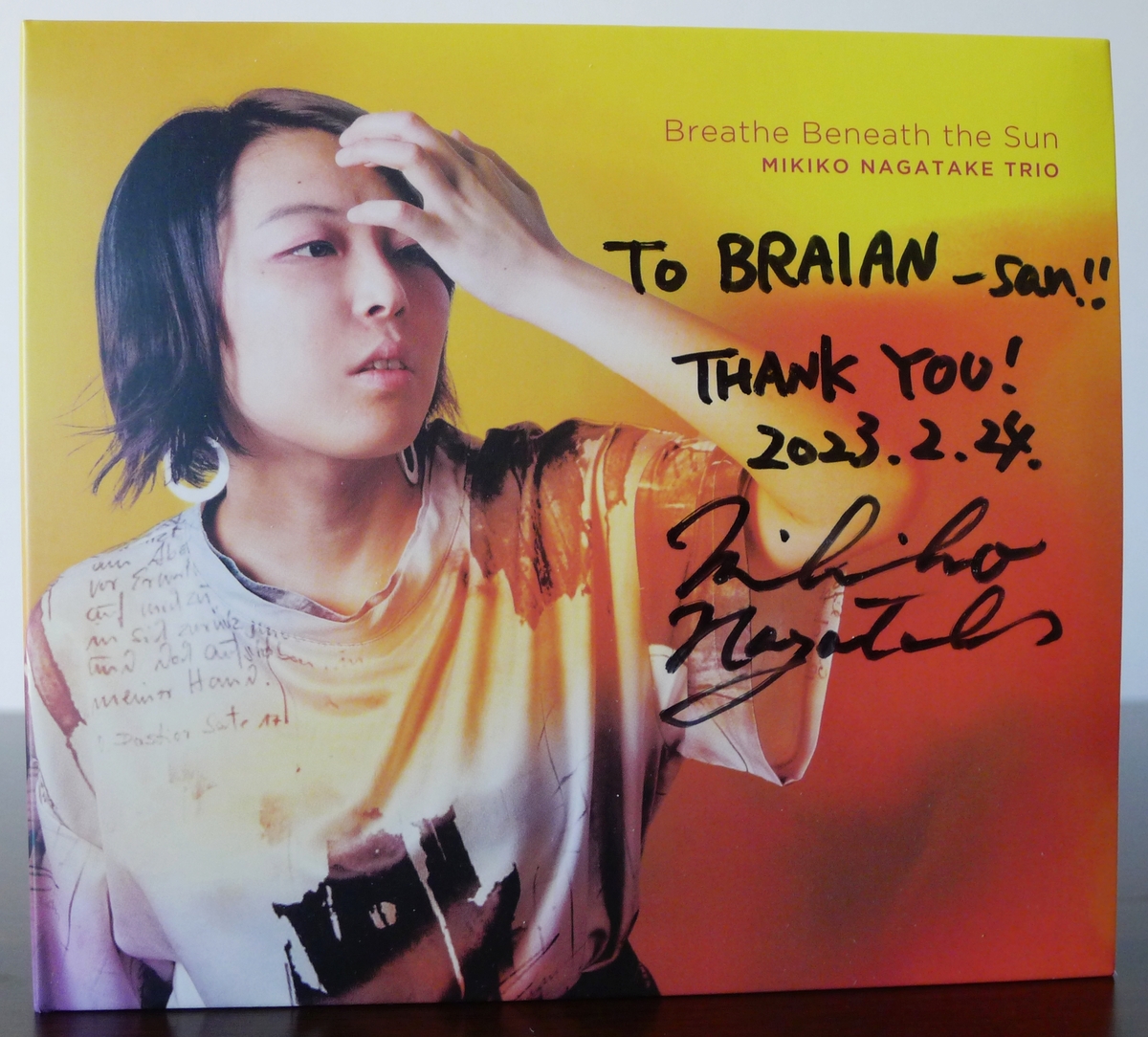
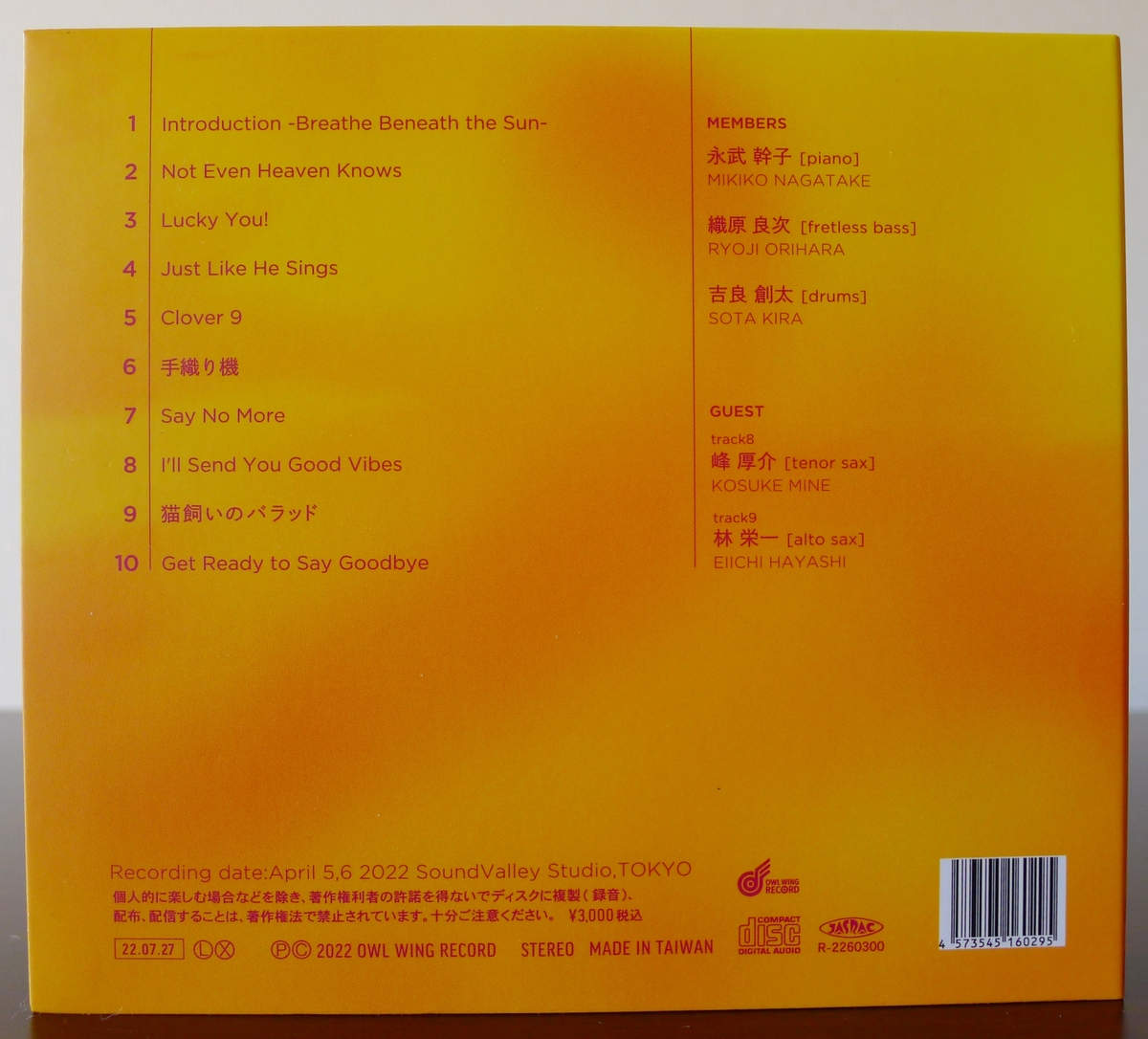
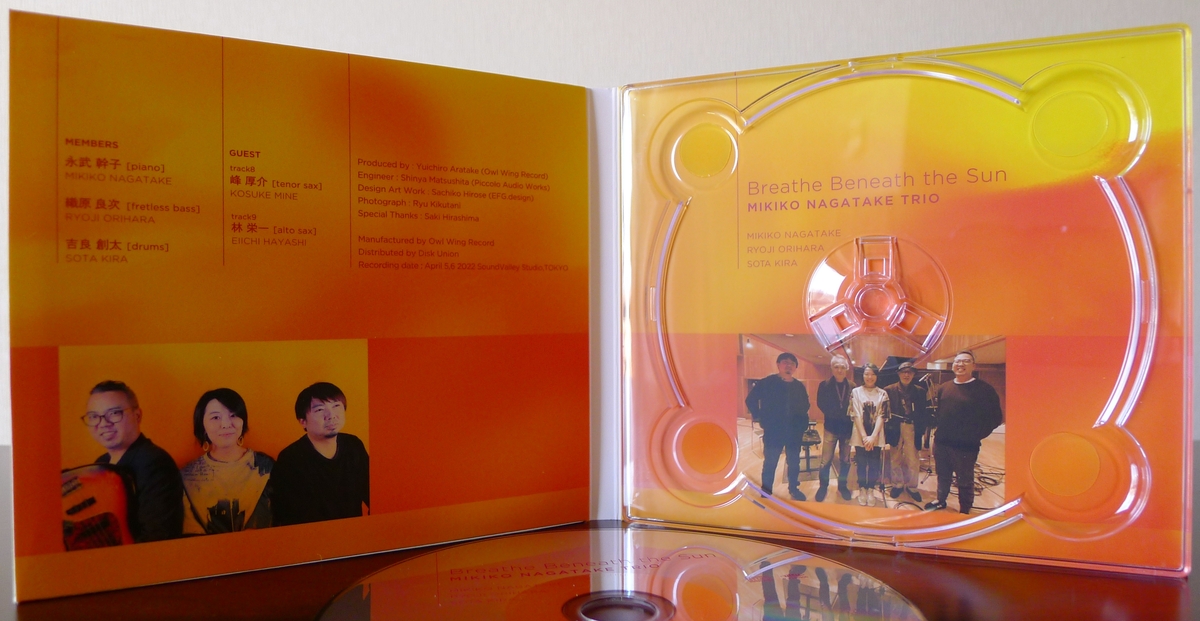
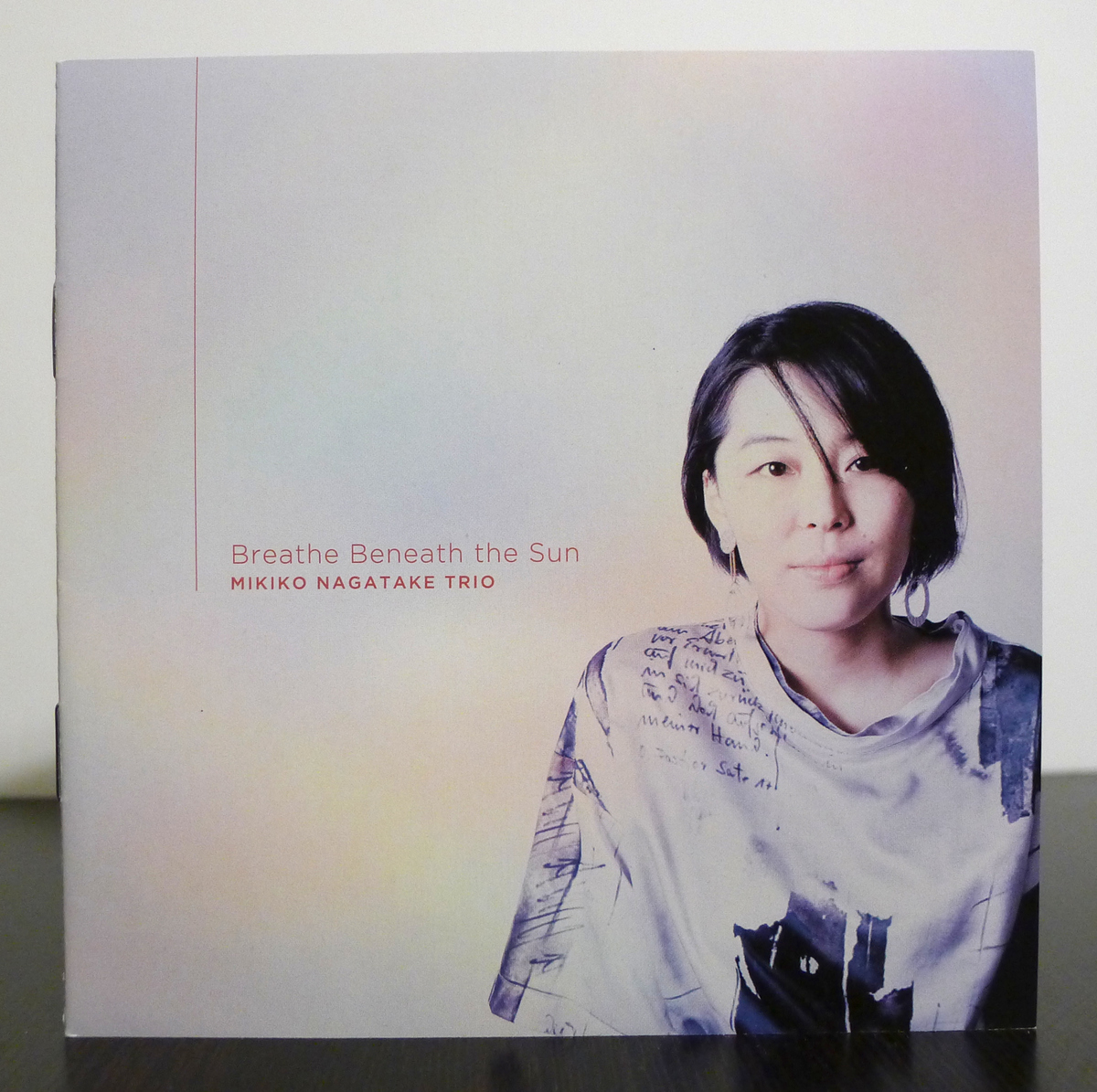
Breathe Beneath the Sun by Mikiko Nagatake Trio
- Mikiko Nagatake - piano
- Ryoji Orihara - fretless bass
- Sota Kira - drums
- Kosuke Mine - tenor sax (track #8)
- Eiichi Hayashi - alto sax (track #9)
Released in 2022 on Owl Wing Record as OWL-041.
Japanese names: 永武幹子 Nagatake Mikiko 織原良次 Orihara Ryoji 吉良創太 Kira Sota 峰厚介 Mine Kosuke 林栄一 Hayashi Eiichi
Audio and Video
- Excerpt from track #1: “Introduction -Breathe Beneath the Sun-”
Jazz of Japan #345 • Jan 3, 2026 • Brian McCrory
Related albums: Jabuticaba (2021), Live at Knuttel House (2021), Solo (2022), Fairway (2024)
Add a comment: