Songs is the current latest album from pianist/composer Hitomi Nishiyama, although her new album Layer due to be released in the next few months. Here, Songs occupies a momentous slot in Nishiyama’s recorded output, as it is a milestone album that looks back over some of her early compositions beginning with her debut album I’m Missing You from 2004. (While I’ve previously introduced over a dozen of her albums here to date, I still have an almost equal amount of her other albums that I will include someday. But for now, as her new album is due out soon, I want to catch up and include her current latest album.)
With a vast collection of original compositions to choose from, Nishiyama not only spent considerable time and effort deciding what to include for this milestone, but she also surveyed her fans and listeners to help choose the final songs to be included on the album. A voting process was even offered her audiences in early 2025. These results resulted in an ad hoc popularity ranking of her songs, with the top three slots going to “Aprilis”, “You’re Not Alone”, and “SAKIRA”. (She wrote about this process on her online journal. These notes also contain a candid account of the pianist’s development of symptoms that resembled Ménière’s disease, causing hearing problems, tinnitus, and vertigo so extreme that she was unable to practice for sufficient lengths of time, much less perform concerts. This is no doubt an extremely difficult situation for a professional musician to suffer through, yet with the courage of a true warrior, she faced these intense challenges directly as she rose to the task of recording and releasing this album.)
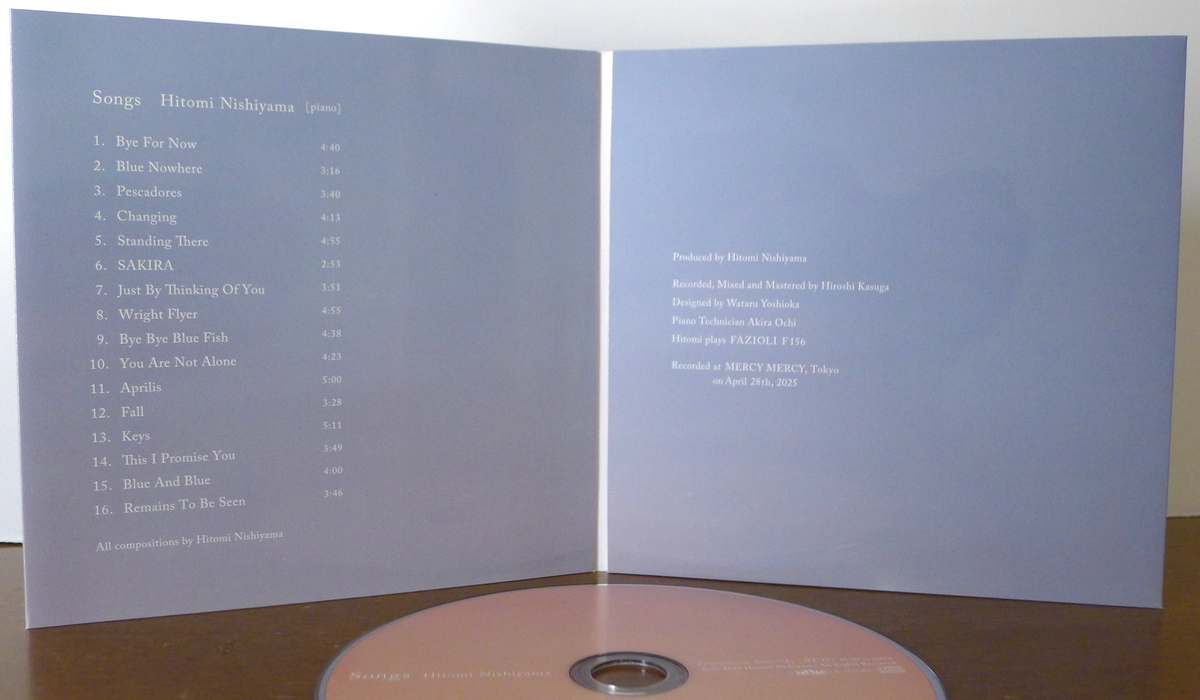
While Nishiyama has previously recorded and released all of these sixteen tracks with different combinations of musicians (usually, piano trios and variations), here with Songs, Nishiyama plays every composition as a solo piano piece. As such, she elevates the music with a simple, unadorned style that contrasts elegantly with the richness of the deep harmonies, melodies, and time structures that are a part of her writing. Here, her solo piano playing exhibits a purity of focus and concentration that allows the notes to develop the music in it’s most genuine form. Additionally, by playing as a soloist, she is free to interpret the rhythmic pulse, flow, and cascade of each song as she chooses, while staying true to her originally composed notes so that the melodies and harmonies can shine. This creates a romantic, rubato looseness that alternates between the beauty of patient development and the flow of an unerringly locked-in rhythmic pulse.
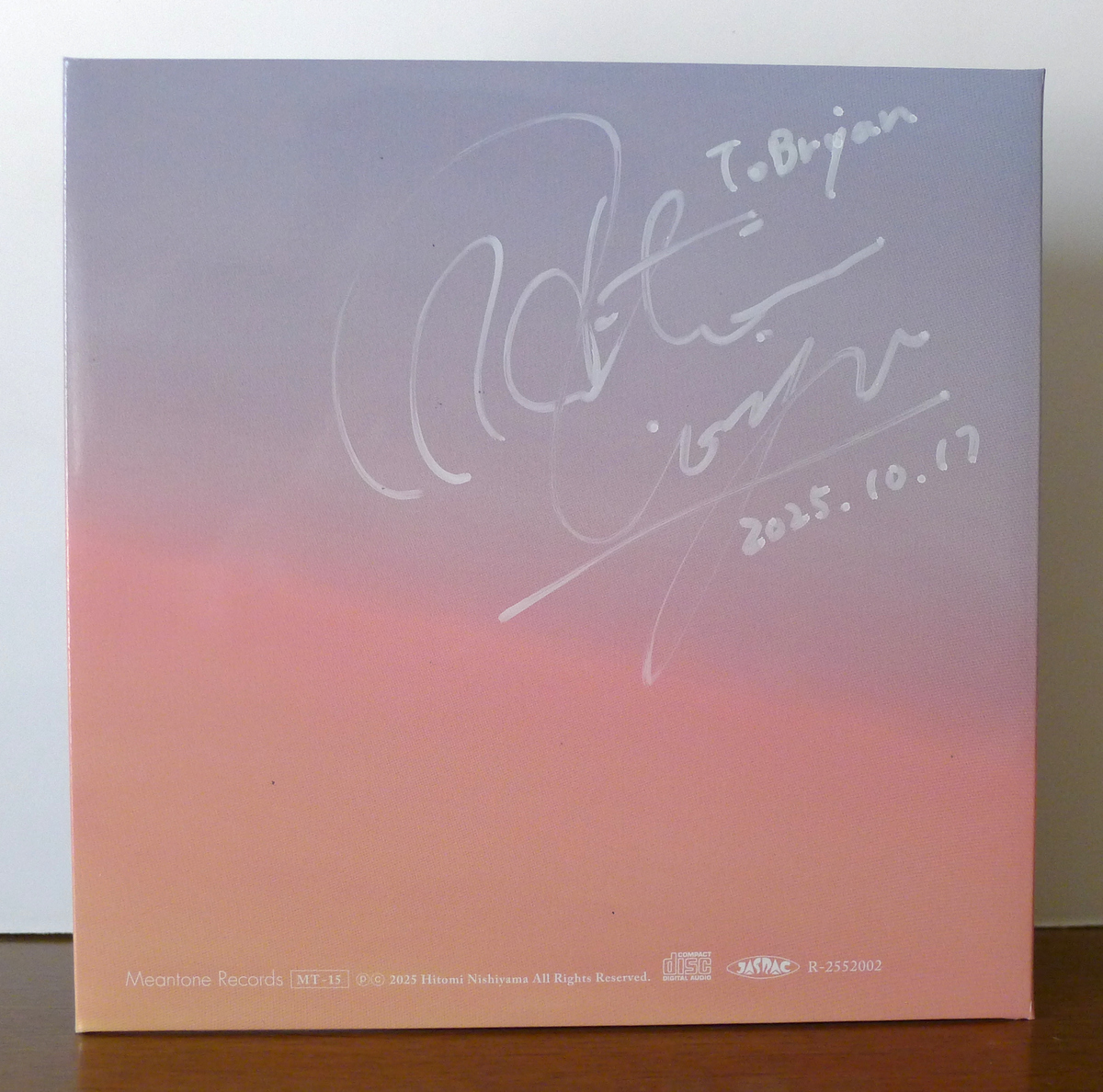
Liner Notes
(Translated from Hitomi Nishiyama’s original Japanese liner notes available online.)
1.Bye For Now
Composed in 2004. Included on Cubium (2006) and In Stockholm (2008).
I often performed this song as a duo with the late Yoshihiko Inoue (tenor sax). These days, I tend to play it during solo concerts or in sessions. Although it’s a song that I play regularly, the two “Spice of Life” label albums that originally included it are completely sold out and not fully available on streaming platforms, so it’s one that I wanted to re-record.
2.Blue Nowhere
Composed in 2002. Included on I’m Missing You (2004) and Parallax (2008).
When I was 22 years old, I created this song through lots of enthusiasm, but without really knowing what I was doing. I recorded it with a slightly different arrangement for Parallax in 2008, and up through that time until the day of the recording, I wasn’t satisfied with my improvisation. I was quite nervous before the recording and unsure about the form and how I should play it. A day before the recording, I was practicing in that same studio and I came up with an arrangement there at the piano. That’s how I ended up performing this song.
3.Pescadores
Composed in 2013. Included on Down By The Salley Gardens (2014) and Faces (2020).
I believe that I first performed this song with a trio at the Fazioli showroom. I wanted to write a simple yet powerful tune, and so I spent a considerable amount of time refining the song’s melody until nothing more could be added or changed. Through this, the melody seems to be of a certain type of Japanese pop song from an earlier era. I suppose that this too is part of what constitutes me as a person.
4.Changing
Composed in 2007. Included on Parallax (2008) and Travels (2013).
This is a song I wrote to be played as a duo with guitarist Takayoshi Baba. I performed it regularly with the Parallax trio and quartet featuring Takayoshi Baba, and it was our most popular song during that time. From 2001 to 2005, I also played in a contemporary gospel group that performed the song “Total Praise” a lot, and I think that may have subconsciously influenced me as the foundation for this piece.
5.Standing There
Composed in 2010. Included on Music In You (2011).
I don’t remember spending that much time writing this song, but for some reason it seems to be admired frequently by non-Japanese listeners. I wonder if there is some subtle Japanese sound that somehow surfaces in it. In 2010, I was living in a place that I could play the piano all day, but in exchange for that, was in an environment that had poor natural lighting. I have a feeling that this song was born out of that lack of sunlight.
6.SAKIRA
Composed in 2006. Included on Many Seasons (2007) and In Stockholm (2008).
This is a song I wrote the day before a concert at the Ritto Arts and Culture Center Sakira. In contrast to the short amount of time it took to write, it is a song that has endured for a long time and has enjoyed a lot of love from listeners. When you listen to European jazz, it is natural to hear 3/4 time signatures with solos and comping that have a floating quality, and this was the first time I put that into practice myself.
7.Just By Thinking Of You
Composed in 2008. Included on Music In You (2011) and Travels (2013).
I personally classify this song in the enka [traditional-style Japanese pop ballad] category, and while there are many other of my compositions with enka qualities, I feel that this one is the most enka of all of them. The melody has a particular intensity that makes me refrain from asking bandmates to take it on, and it ends up being a song that is rarely played. Looking at it now, the title also carries the feeling of enka.
8.Wright Flyer
Composed in 2012. Included on Shift (2014).
This was a popular song from “Parallax”. Originally I wrote it for a quartet with guitar with shared melody, so I thought it might be impossible to perform on solo piano. But, since there were lots of requests for this song, I came up with a way to play it and to re-record it as a solo.
9.Bye Bye Blue Fish
Composed in 2014. New recording.
This is the only composition that was new recorded for the first time for this album. I composed this 11 years ago, so it’s not a new composition and it’s one that I’ve performed often at live concerts. I was writing this song when a blue fish that I kept at home passed away, so I gave it this title. It’s an enka-style song in a major key. I was vacillating between whether to play it lightly or forcefully, but this time, I played it somewhere in the middle. With a trio, I go all out.
10.You Are Not Alone
Composed in 2005. Included on Cubium (2006) and In Stockholm (2008).
I think the reason that my country-wide debut album Cubium was so widely accepted was because of this song. When I was living in the Kansai region, I used to play Bill Evans songs and arrangements exclusively when I would perform with a trio, once or twice a month, almost as if we were a research study group. Tribute albums to Evans usually include one original song that was inspired by him, and this song was written with that intention in mind.
11.Aprilis
Composed in 2004. Included on Parallax (2008), and I’m Missing You (rerelease) (2011).
It’s not an exaggeration to say that this re-recording project was planned for the sake of this song. I still frequently play this song as the closer at jazz festivals and concerts. This song’s structure is fixed, so it consistently ends in six minutes. For solo piano, I thought six minutes seems long, so I condensed it a bit. Since I’ve been playing this song for such a long time, I sometimes forget whether I’m playing the actual melody or a reinterpretation of the melody, and I really felt that it was difficult to deconstruct the arrangement. If I have the chance for another solo recording, I’ve like to give it another try.
12.Fall
Composed in 2014. Included on Mahoraba (2021).
During the coronavirus pandemic, I started to livestream piano solo concerts from home. Probably because this was a song that I played many times during those livestreams, there were a number of requests for me to record this as a solo. What was unusual was that I came up with the intro motif before the melody. After writing it, I realized that the intro motif seems to serve the same purpose as the opening riff for a heavy metal song. Since then, I’ve been playing it with that feeling.
13.Keys
Composed in 2014. Included on Live (2016).
I wrote this with the same half-time shuffle as Alicia Keys’ song “If I Ain’t Got You”. For the band “Parallax”, I always aimed to write pop-style songs as much as possible, and I had the impression that “Parallax” songs were more like pop guitar trio than jazz piano trio. I really like this song because it completely shows my pop side. Still, playing it alone is truly hard.
14.This I Promise You
Composed in 2003. Included on I’m Missing You (2004).
Since this was the first song on my independently released album, many listeners may have discovered my playing through this song. However, after the album was released, I thought that my songwriting skills were still quite unpolished, so I decided to study again with a composition teacher. Under their guidance, I re-learned harmonic theory. Looking back now, the songs I wrote when I was 23 were created with a lot of passion and spirit, and that type of energy is also a good thing.
15.Blue And Blue
Composed in 2007. Included on Travels (2013).
This is a song that was originally written for an assignment from my composition teacher. I wrote the music and lyrics, and the first version featured vocals by a singer who was also a student of my composition teacher. Unexpectedly and for some reason, there were a lot of requests to include this song this time, along the lines of “I’d love to hear an instrumental version.” Oh, that’s right, this song had previously only been released as the vocal version.
16.Remains To Be Seen
Composed in 2008. Included on Sympathy (2013), Travel (2013).
Out of all my compositions, I think that this song is the one that most leaves behind the feeling of loneliness after a performance. During live concerts, the “ta-da” ending is still slightly embarrassing, and I wanted to end with a feeling of naturally passing away. Perhaps this reflects my view of life and death.
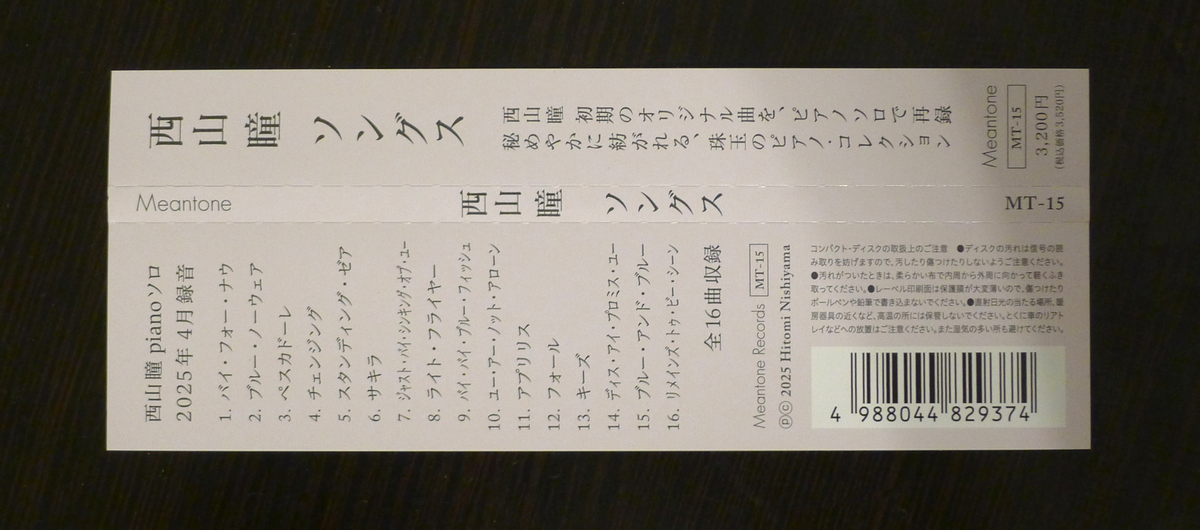
Obi Notes
Hitomi Nishiyama re-records her early compositions for solo piano
A gem-filled collection of piano pieces, secretly assembled
Audio and Video
Songs by Hitomi Nishiyama
- Hitomi Nishiyama - piano
Released in 2025 on Meantone Records as MT-15.
Japanese names: 西山瞳 Nishiyama Hitomi