
Hiroshi Fukutomi Quintet: Rings of Saturn
Jazz of Japan #346 — Guitarist Hiroshi Fukutomi’s first album is Rings of Saturn from 2010. On this recording, the...
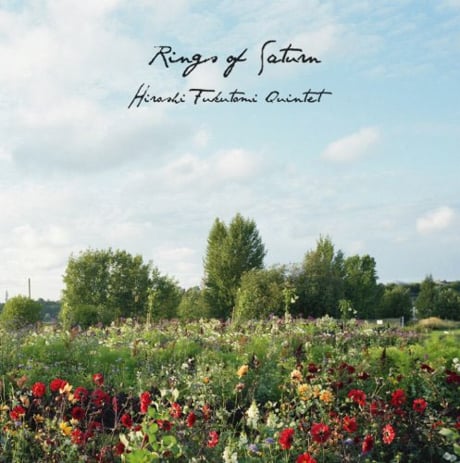
Guitarist Hiroshi Fukutomi’s first album is Rings of Saturn from 2010. On this recording, the guitarist plays modern jazz compositions under the flag of his own quintet featuring Masahiro Yamamoto on alto and soprano sax, Koichi Sato on piano (also on Fukutomi’s 2014 followup Memory Stones), Hiroshi Ikejiri on bass, and Ryo Shibata on drums.
Fukutomi’s debut album runs for 54 minutes and features seven original compositions, six from Fukutomi and one from saxophonist Yamamoto. The songs are composed by Fukutomi to be platforms for interplay, where the front-most instruments of guitar, sax, and piano merge and relay with an intimate immediacy, rather than each musician stepping back to make room for longer periods of singular adlibs. As with great jazz combos, there’s close collaboration where all five members listen closely to one another, pick their moments to step forward or back, and raise or relax the tension with the right-timed notes and rhythms.
The first six tracks are from leader Fukutomi and display a thoughtful sense of development. The opening songs, “Rings of Saturn” and “Lost and Found” are comfortable on the surface but potentially complex, with extra structures and ornaments added for increased interest, fun, and depth. For example, the latter offers odd-time meters (11/4 and others?) with changes and extra beats to offset regular expectations. Through the strength of the snappy rhythms, melodies, and progressions, it all works together to make elaborate yet catchy tunes.
Track #3 “Lotus” is a backing off from the fire, a relaxing meditation of hopeful optimism. The pretty lines filled with a spiritual, uplifting sound, mellow yet involved. #4 Sakasama-no-Tokei features a steady soft-rock pulse, flexible and full of life with time to breathe, relax, and be aware. #5 “The Place We Had” is patient as mild mysteries of memory are presented and unwrapped. #6 “New Moon” is another swinger with odd-beat measures to increase the journey’s adventure. These sounds recall some of Bungalow’s (with Yamamoto, Sato, and Ikejiri) original music and playing. In a similar mold, #7 “Chasing” is an exciting song written by saxophonist Yamamoto and is a mature and lyrical shapeshifter, swirling and folding time.
Incidentally, Masahiro Yamamoto, along with Sato and Ikejiri, was a founding member of Bungalow, a richly eclectic jazz quartet formed in 2010. They released two albums together with Yamamoto on sax and composing duties (2011’s Metropolitan Oasis and 2013’s Past Life) before Yamamoto left, after which Bungalow released three more albums with Australian saxophone player Mike Rivett. In the same jazz family sense and general time period, bassist Ikejiri also plays on Koichi Sato’s debut release Utopia (2011).
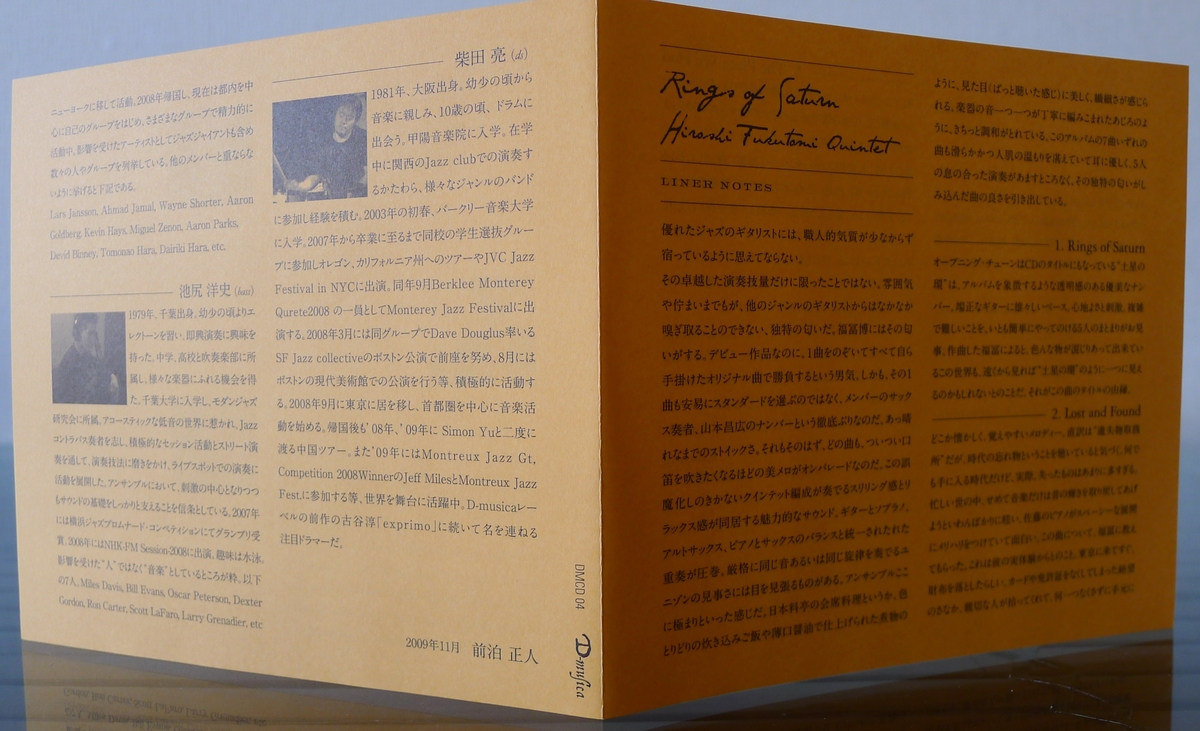
Liner Notes
(Translated from Masato Maedomari’s original Japanese liner notes.)
I can’t help but think that great jazz guitarists seem to have considerable craftsmanship in their approach to some extent. This is not limited to their outstanding performance skills. Even the distinctiveness of their atmosphere and presence can be noticed, perhaps moreso than guitarists of other genres. I sense that type of characteristic in Hiroshi Fukutomi. Despite this being his debut album, he has the courage to enter the ring with all original songs that he wrote, aside from one track. Further, for the one cover song, he did not simply choose a jazz standard, but he went so far as to pick a song by Masahiro Yamamoto, the band’s sax player. The degree of self-discipline is admirable. And it’s no wonder, since each song offers up a beautiful melody that compels you to whistle along.
The straightforward quintet form produces an attractive sound where both thrilling and relaxing sounds coexist. Guitar and soprano, alto sax, piano and sax…the balanced and unified ensemble is breathtaking. Similarly, their unison performance on the same note or melody can be astonishing. It feels like this is the pinnacle of the ensemble. It’s like a kaiseki meal at a traditional Japanese restaurant, with various rice dishes, boiled and stewed foods cooked with light soy sauce, and everything looks beautiful at first sight, with a delicate sensibility. The sounds of the instruments are carefully woven together like wickerwork, taking on a perfect harmony. All seven tracks on this album are filled with the smooth warmth of skin, pleasing to the ears. The synchronicity of the five musicians is perfected and brings out the full beauty of each song.
1.Rings of Saturn
The opening tune “Rings of Saturn” is the CD’s title track. This is a number with a refined transparency that symbolizes the essence of the album. An elegant guitar with a masculine bass. Comfortable yet stimulating. Bravo to the five musicians who pull off such difficult and complicated things with ease together in unison. According to the composer Fukutomi, the song is about this world that is made up of many different things mixed together, but something that may appear to be a unified thing when viewed from afar, like the rings of Saturn. That’s the reason for the title of this song.
2.Lost and Found
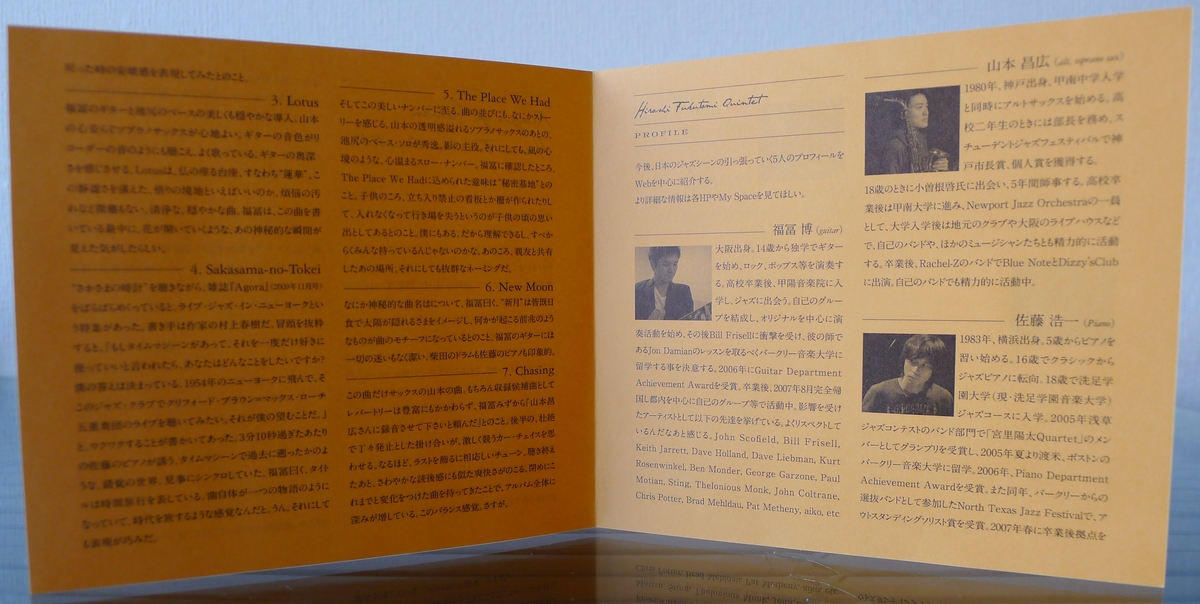
The melody is nostalgic, easy to remember. The literal translation is “the lost and found office” (遺失物取扱所, ishitsubutsu toriatsukaijo), but when you listen, you notice that it’s about the forgotten things of the ages. This is a time when we can get anything, but in reality, the things we have lost are innumerable. It’s dazzling, seeming to be saying, let’s restore in this busy world something, even just music at least, to the brilliance of the past. Sato’s piano is fascinating in the way he adds balance to the spacey progression. Fukutomi explained this song to me. It’s a story from his personal experience. It seems that just after arriving in Tokyo, he lost his wallet. While lost in the despair of losing his credit cards and drivers license, he expresses the sense of relief he felt when some kind person found the wallet and returned it to him. Nothing was missing.
3.Lotus
A beautiful and gentle introduction from Fukutomi’s guitar and Ikejiri’s bass. Yamamoto’s soprano sax is soothing and relaxing. The guitar tone almost resembles a recorder playing finely. It makes you feel the depth of the guitar. Lotus is the pedestal the Buddha sits upon, that is the “lotus flower” (蓮華, renge). It’s a pure and gentle song, filled with the tranquility that could perhaps be compared to a state of enlightenment, completely free of worldly desires. Fukutomi explained that in the middle of writing this song, he felt a mysterious moment where it seemed as if he could see a flower blooming.
4.Sakasama-no-Tokei (Upside-Down Clock)
While listening to “Sakasama-no-Tokei”, I was flipping through the magazine Agora (November 2009 issue), and there was a feature on live jazz in New York, written by the author Haruki Murakami. Quoting from the beginning: “If you were allowed to use a time machine in any way that you like just once, what would you want to do? My answer is decided. I would like to fly back to New York in 1943, to hear Clifford Brown and the Max Roach Quintet perform live at a jazz club there. That’s what I want.” It was an exciting piece. Around the 3-minute 10-second mark, Sato’s piano arouses a world of illusion, like going back to the past in a time machine. There was perfect synchronicity. Fukutomi explains that the title refers to time travel. The song itself is like a story with the feeling of traveling through time. Hmm. Be that as it may, it’s skillful expressed.
5.The Place We Had
And we come to this beautiful number. It feels like there is also a story being told through the sequence of songs. Yamamoto’s soprano sax is filled with translucence, and following that is an excellent bass solo from Ikejiri. A hero in the shadows. Nevertheless, it’s a heartwarming slow number, like a calm state of mind. Fukutomi confirmed that the “The Place We Had” contains the meaning of a secret base or hideout. He remembers experiences from childhood when “No Trespassing” signs were put up and caused him to suffer the loss of places that he used to go. The same thing happened to me. That’s why it’s so understandable, and I feel like almost everyone has had similar experiences: Back then, that place that I shared with my best friend. In any case, the naming of this song is exceptional.
6.New Moon
Regarding the somewhat mysterious song title “New Moon” (新月, shingetsu), Fukumori speaks of the image of the sun being hidden during a total solar eclipse, and how the song’s motif is like a premonition that something is about to happen. Fukumori’s guitar is graceful without any sense of hesitation. Shibata’s drums and Sato’s piano are also striking.
7.Chasing
This song is by saxophonist Yamamoto. Although Fukutomi had a wide repertoire of songs to choose from for the recording, he asked Masahiro Yamamoto to allow him to record one of Yamamoto’s songs. In the second half, the fierce battle of exchanges brings to mind an intensely competitive car chase. Yes, it’s a suitable last song to cap the album. After listening, there’s a satisfaction similar to the invigorating feeling that remains after reading a good book. By including a song at the end that is a change from those before, it adds more depth to the overall album. There is a sense of balance. Just as you would expect.
Hiroshi Fukutomi Quintet Profile
Following are profiles of these five musicians, leaders in the jazz scene in Japan, drawn mainly from their websites. For more details, check their respective websites or My Space pages.
Hiroshi Fukutomi (guitar)
Born in Osaka, Hiroshi Fukutomi started learning guitar on his own at age 14 and played rock and pop music. After graduation from high school, he entered Koyo Conservatory of Music and discovered jazz. He formed a group and began to perform his own music. Later, he was deeply influenced by Bill Frisell and decided to study at Berklee College of Music in order to take lessons from Jon Damian, who was Frisell’s teacher there. In 2006, he received the Guitar Department Achievement Award. After graduating, he returned permanently to Japan and has been actively performing around the Tokyo area with his own group and others. He offers the following artists, who he deeply respects, as influences: John Scofield, Bill Frisell, Keith Jarrett, Dave Holland, Dave Liebman, Kurt Rosenwinkel, Ben Monder, George Garzone, Paul Motion, Sting, Thelonious Monk, John Coltrane, Chris Potter, Brad Mehldau, Pat Metheney, aiko, etc.
Masahiro Yamamoto (alto, soprano sax)
Born in Kobe in 1980, Masahiro Yamamoto started playing alto saxophone when he entered Konan Junior High School. In the second year of high school, he served as section leader in the Student Jazz Festival and received the Kobe City Major’s Prize and the Individual Award. When he was 18 years old, he met Hiroshi Ozone, who he studied under for 5 years. After graduating from high school, he entered Konan University and became a member of the Newport Jazz Orchestra there. After entering university, he was active with performances with his own band and other musicians at local clubs and live venues around Osaka. After graduating, he performed at Blue Note and Dizzy’s Club with Rachel-Z’s band. He is currently active and performing with his own band.
Koichi Sato (piano)
Born in Yokohama in 1983, Koichi Sato started learning piano at age 5. At 16, he switched from classical to jazz piano. At 18, he enrolled in the jazz course at Senzoku Gakuen College University (now Senzoku Gakuen College of Music). In 2005, he was a member of the Yota Miyazato Quartet at the Asakusa Jazz Festival, who received the grand prize in the band category. In the summer of 2005 he moved to the United Stated to study as a student at Boston’s Berklee College of Music. He received the Piano Department Achievement Award in 2006. In that same year, he was picked for Berklee’s select band of musicians to perform at the North Texas Jazz Festival, where he won the Outstanding Soloist Award. In the spring of 2007, he moved his base to New York to perform there. He returned to Japan in 2008, where he is vigorously active with his own band and various other groups. Starting with the jazz giants, he lists numerous people and groups that have influenced him. To avoid overlapping with other the members, he also offered the following influences as additional examples: Lars Jansson, Ahmad Jamal, Wayne Shorter, Aaron Goldberg, Kevin Hays, Miguel Zenon, Aaron Parks, David Binney, Tomonao Hara, Dairiki Hara, etc.
Hiroshi Ikejiri (bass)
Hiroshi Ikejiri was born in Chiba in 1979. He started learning the Electone (Yamaha electronic organ) from a young age and got interested in improvised music. He joined the band in junior high and high school where he gained the opportunity to play various instruments. After entering Chiba University, he joined the modern jazz study class. Drawn to the world of acoustic low notes, he aspired to become a jazz double-bass player. He honed his skills by actively playing at sessions and street performances, developing into performances at jazz spots. In an ensemble, he believes in being a stimulus at the center while also providing a solid foundation for the sound. He won the Grand Prize award in the 2007 Yokohama Jazz Promenade Competition and appeared on the NHK-FM Session-2008 the following year. His hobbies include swimming. The essence of his influences are not “people” but “music”, and include the music of the following seven artists: Miles Davis, Bill Evans, Oscar Peterson, Dexter Gordon, Ron Carter, Scott LaFaro, Larry Grenadier, etc.
Ryo Shibata (drums)
Born in Osaka in 1981, Ryo Shibata had a love for music at a young age and began learning drums at the age of 10. He entered the Koyo Conservatory of Music, and started to perform in jazz clubs in the Kansai region, accumulating experience by playing in various bands and genres. In early spring 2003, he entered Berklee College of Music. Starting in 2007 until graduation, he played in the select student band with tours in Oregon, California, and at the JVC Jazz Festival in New York City. In September of that same year, he played at the Monterey Jazz Festival in 2008 as part of the Berklee Monterey Quartet. Continuing his musical activity, in March 2008, he participated as first chair as part of the same group with the SF Jazz Collective led by Dave Douglas for a concert in Boston, and played at Boston’s Institute of Contemporary Art in August. He moved to Tokyo in September 2009 and began to actively perform around the Tokyo Metropolitan area. After returning to Japan, he performed twice with Simon Yu on tour in China, in 2008 and 2009. Also in 2009, he played at the Montreux Jazz Festival with Jeff Miles, winner of the Montreux Jazz Guitar Competition 2008, in addition to other activities performing on the world stage. He is a drummer who continues to build on his reputation with this album and the previous release from D-musica, Jun Fuyura’s Exprimo.
Obi Notes
The resonance of five distinct personalities blossoms with a rich harmony.
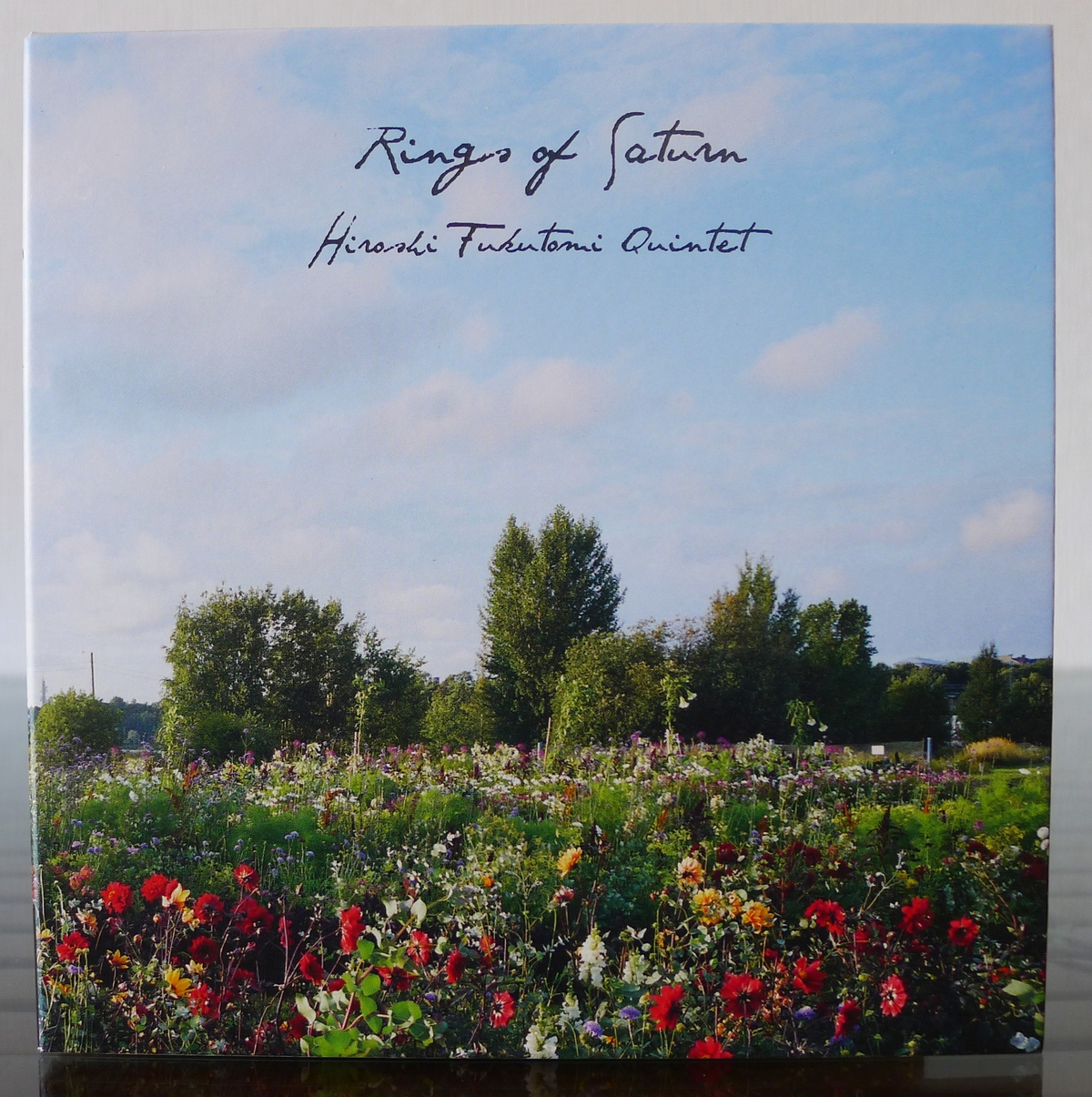
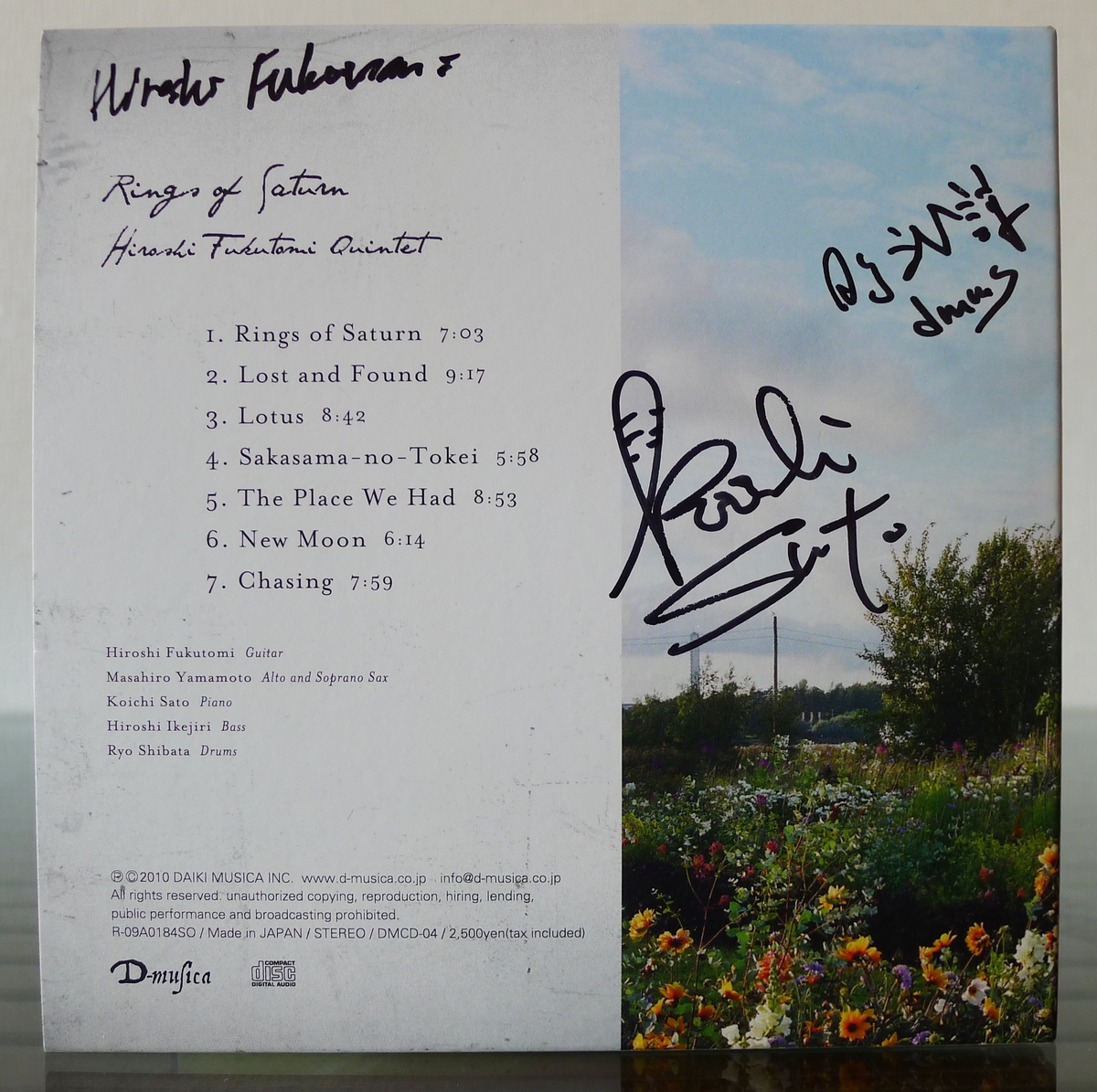
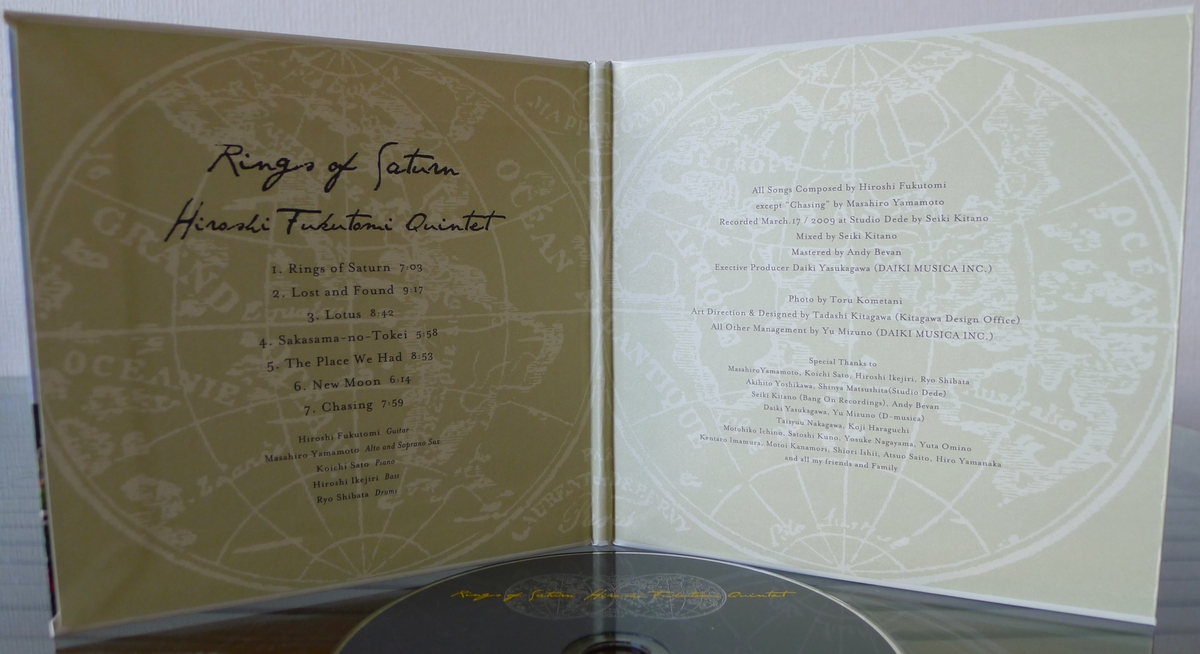
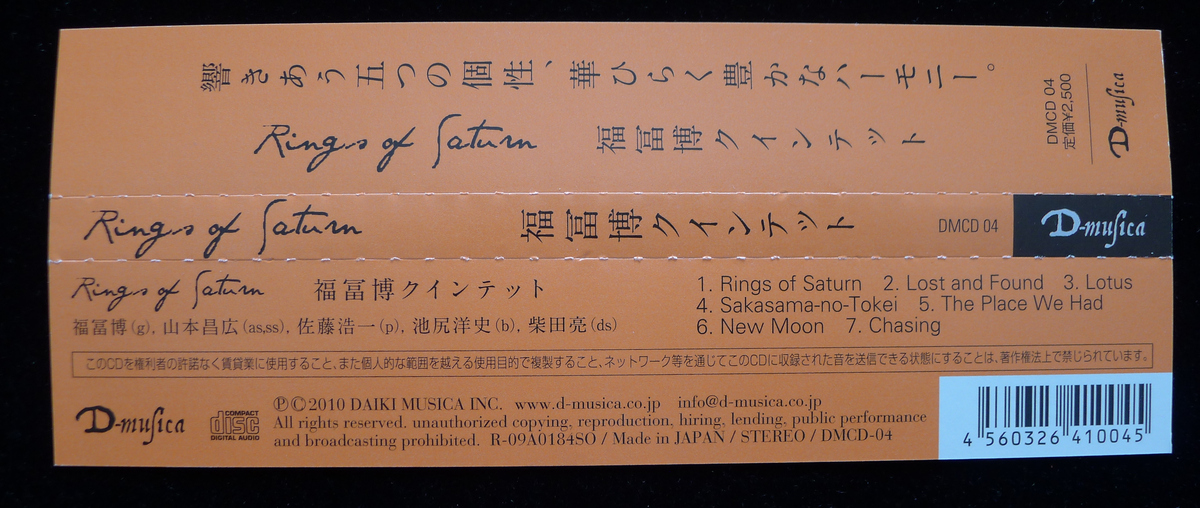
Rings of Saturn by Hiroshi Fukutomi Quintet
- Hiroshi Fukutomi - guitar
- Masahiro Yamamoto - alto and soprano sax
- Koichi Sato - piano
- Hiroshi Ikejiri - bass
- Ryo Shibata - drums
Released in 2010 on D-musica as DMCD-04.
Japanese names: 福冨博 Fukutomi Hiroshi 山本昌広 Yamamoto Masahiro 佐藤浩一 Sato Koichi 池尻洋史 Ikejiri Hiroshi 柴田亮 Shibata Ryo
Audio and Video
- Full album (YouTube)
- Full album (Spotify)
- “Lotus” (track #3) — solo guitar version
- Excerpt from track #2: “Lost And Found”
Jazz of Japan #346 • Jan 10, 2026 • Brian McCrory
Related albums: Metropolitan Oasis (2011), Utopia (2011), Past Life (2013), Memory Stones (2014)
Add a comment: